Blog Post #33: When It All Comes Down and Dealing with Grief

It’s hard sitting here and finally writing this blog post. It’s a post that’s been on my mind for years, my courage to write it ebbing and flowing like a tide.

Well, today, the tide breaks, and I’m here facing an emotional post I’ve been putting off from writing for a long time.

The last four years have been an emotional journey of infertility for my husband and I, but probably not the story of infertility you’re expecting to hear. My husband and I do not have an issue conceiving children, but keeping them long enough to survive outside the womb. It is with bitter, salty tears that I tell you all we’ve lost not one, not two, but five pregnancies in a row over the past four years, and this has rocked us emotionally.

My previous surgery that I had back in 2022 was not the answer to what’s keeping us from having children, and, as much as I hate to say it out loud, pursuing specialists has also come up short on providing an answer overall. They have no answers to give on why we’ve lost five babies, and that ate me up for a long time, making me a hollow, jealous version of myself that I detested.

I’ve realized now that I’ve been in circles of grief for the past four years. After each bout of dashed excitement from losing another baby, I drove myself into a self-destructive grief cycle for the following six months, emerging only when I’ve gained enough hope to run headlong into trying again. This culminated in 2023, when we lost three babies back to back, and my husband and I decided to run away on an expensive New England road trip that we’re still paying off now. That trip brought us back together, but we’re still reeling from the psychological blow this entire experience has been. We’re still wondering if it’s worth trying again, and we’re both petrified that it’s going to just blow up in our faces. We’re both people who never yearned for careers, but for kids, and so this entire experience has had us both questioning what we’re supposed to do with our lives, which is kind of silly because raising kids still means you need to be your own autonomous person, but raising kids has always been something that seemed like a higher calling outside of pursuing a career.

Ultimately, we’ve decided that if we can’t have natural children we’ll adopt, and adopting has always been something I’ve wanted to pursue. It’s just seeing everyone my age so easily have children, I’m literally surrounded by many female friends who are stepping into motherhood, something that I seem to be repeatedly rejected from. Finding life outside of a goal I’ve had as long as I can remember has been difficult, but I knew I didn’t want to write this blog post until I had been on the other side, until I had realized that I needed to decenter having kids from my life; that only by doing that was I able to move on from the trauma my infertility journey had caused me . . .

To anyone on a similar journey in their own lives, I know full well that nothing I say could bring you any real peace or comfort. Still, the only thing that gave me solace was that I am not the only woman suffering from this situation; and neither are you. You are not alone, us women affected by multiple miscarriage are with you in spirit and grief.

This blog post isn’t just a complete trauma dump, in some ways it’s an announcement of my return. Fighting through this pain the last four years has been the hardest thing I’ve ever experienced in my life, but it’s also shown my how strong I truly am.

In six months I will be debuting my first novel as a Closed Door Romance author, and I hope that you will continue to support and watch as I pursue the passions that are within my control. My goal is to start publishing blog posts multiple times a week as I did in the past, and I encourage you to visit my website to get to know me better as an author and writer.

Thank you all for your support, logging in today to see how many of you liked my posts from years ago gave me hope that this was not all-for-naught.

Sincerely, Chelsea Gross

(Anastasia Frost’s real name)

Website: www.etherealquill.com

LinkedIN: www.linkedin.com/in/cgross1218/

Blog Post #32: Best Books on Writing, Screenwriting Tricks for Authors and How to Steal Hollywood


Alexandra Sokoloff’s Stealing Hollywood: Screenwriting Tricks for Authors is easily one of the best plotting books I have ever purchased. It is a vital tool I use for every plot I’ve written since purchasing the book.

Now, Alexandra Sokoloff is notoriously protective of the contents of this book, and because of that I will be disclosing no direct information including quotes, techniques, or really anything. I’m sorry for that, but ask Sarra Cannon of HeartBreathings on YouTube about it…

What I can say about it is that it’s the THICKEST, LARGEST plotting book I own, and it is chock FULL of crucial information, such as popular scene additions and where they go in the first, second, or third act.

She also includes movie/story break downs, examples, and chapters on dialogue, stakes, love stories, fairy tales, villains, creating suspense, plot twists, and so much more!

I heavily suggest this book to any writer. Even for pantsers the information is vital, especially when you are stuck in a writer’s block and don’t know where to head.

You can find this book on Amazon!

Short Story: Nightshade and Pomegranate, Part Two


“Zeus,” she said, her voice small.

“Where is the Goddess of Spring?”

“In the gardens,” Calypso said. Zeus nodded to her, and she scampered off, escaping the ire or desire of the King of Olympus.

“You heard her, brother,” Zeus said, his voice dark. Without looking, his shadow peeled away from itself, and a secondary shadow walked away, silhouetted against the wall. It crept up to an open window, and slunk away outside.

“What is that horrible stench?” Demeter asked, annoyance across her face. Zeus approached her, attempting to calm the nervous mother.

Persephone sat outside in the gardens, alone, still cultivating multiple bushes. A shadow came over her, tall and dark, and she turned towards it, and had to contain her excitement. Hades stood before her, his physical form materializing out of the shadow that he had arrived in. His tall, slender frame came into reality, his pale, gray skin and gaunt face looked down at his love with adoration and affection.
To Persephone, Hades smelled like autumn leaves and his shadow was a deep shade of black she was never able to get her flowers to achieve.

To Hades, Persephone was like a cherry blossom tree in bloom: timelessly young, elegant, and floral.
Hades took Persephone into his arms, holding her against him. “I’ve come to claim you as my bride. I’ve come to bring you to the Underworld.”

Persephone looked at him, beaming with excitement. “I want to be there with you, I want to go there now.”

Hades approached the flowers and bushes that Persephone had grown, and from it he crafted a crown of Pomegranates, Roses, and Nightshade flowers, a floral crown symbolic of their love and matrimonial bond. Hades loved Persephone more than anything he had ever known, her beauty was beyond any other Goddess in existence now, or ever to exist, and he was willing to do anything to have her as his Queen. Gently, he placed the crown upon Persephone’s head.

Zeus edged towards Demeter.

“What do you want?!” She said, her voice harsh. She didn’t trust the God of Olympus, the man who would go to great lengths to disrespect his wife and sleep with anything that moved.

“What is so bad about letting your daughter make her own choice?” He asked, his voice soft.

Demeter looked at him with daggers in her eyes, she bit her lower lip in anger.
“Let my daughter, the Goddess of Spring, lock herself in the Underworld to be the Queen of the Dead?! What kind of mother would I be if I allowed her to do that?!”

At this point, all of the Gods were looking at the pair, their eyes boring holes into Demeter. Demeter’s eyes flicked around the room, she saw that Persephone was nowhere to be found.

“You all smelled him, the stench of death he brings with him!” She cried, whipping around the room, looking for her daughter. “You all know he came tonight, snuck in the manor behind my back, and yet you all laugh in my face and console me with your feigned kindness. Where is he?! Where is my daughter?!”

It was at that moment that the room fell into hushed whispers, everyone’s eyes darting back and forth.

Within a few more moments, the back doors to the garden swung open. In came Persephone and
Hades, wrapped in each other’s arms, a crown upon Persephone’s head.

“I’ve chosen my suitor, mother,” she said, happiness written across her entire being. “I wish to marry Hades!”

Blog Post #31: Where Did I Go?

Hey guys!

Life has been a whirlwind these past three weeks, and I’m sorry for not giving you all a head’s up on what I was doing.

To cut straight to the chase: I had neck surgery and I started freelance ghostwriting romances! I am no longer unemployed, I am SELF EMPLOYED!

Like I said, it’s been wild!

I am recovering well from surgery and I have three clients who I am regularly turning pages into for cash. I am finally a paid writer! All three of them are looking to be long term clients and I am so happy and grateful for them!

I started an LLC for my ghostwriting/editing business, and as soon as I have the official declaration of my business, I’ll be promoting it on this blog 🙂

You can still look forward to my short stories and blog posts (Nightshade and Pomegranate is still getting written, no worries), I’ve just been having a hell of a time juggling everything with three clients who I am trying to impress with my work and consistency!

I am very thankful for my surgery, it was to correct a genetic condition inherited from my grandmother, and it should be the answer to me becoming a mother. Once my calcium regulates naturally, I will be able to start trying again with my husband. I am thrilled and terrified. Losing our first pregnancy last year still chokes me up with tears, and I’m petrified that I’ll experience that loss again. However, I can’t let that fear swallow my life whole.

Fear is the mind killer, after all.

Short Story: Nightshade and Pomegranate, Part One

“Demeter, what if he comes for her?”

“Come? Here? He’s the God of Death, would he dare walk the halls of Olympus and cross me?”

Demeter turned to the nymph, her round face and dark eyes looked down with smoldering fury and annoyance. Her lips pulled in a tight line, curled downward at the sides. Her hand pulled to her hair, pushed a strand behind her ear. Demeter’s eyes flicked around the room, scanned the other gods in attendance, deities that she had known since their births, since the destruction of the Titans, and since Zeus had taken his throne over them all. They had all come tonight in anticipation of who her daughter, Persephone, would choose as her king.

Gathered in the room were the bachelors that Demeter had chosen: Ascelpius, Hermes. She had even invited married Olympians who despised their wives like Hephaestus, which drew the criticism and interest of the rest of the gods who now stood in the halls of the sprawling manor, filling it with the murmurs of their words.

“All of the men of Olympia are here,” a feminine voice said.

“All of the bachelors except for one,” another, masculine chided.

Aphrodite looked to Eros, a gleam in her eye. “Demeter can try what she may, but you and I can feel the tug between her daughter and the God of the Underworld. I can’t blame Demeter, her daughter, the Goddess of Spring, so overflowing with life; to watch her wither away at the side of Death himself.”
“Would she wither?” Eros asked, a finger pulled to his puckered lips in sincere thought. “Or would she become something new?”

“Persephone’s change to anything other than her mother’s babe will be like withering in Demeter’s eyes,” Aphrodite said, watching Demeter and her devoted nymph, Minthe, talk to one another in fevered, hushed pitches.

“Where is the woman of the night, anyway? Where is Persephone?”

“Probably out in the gardens. That girl is always looking for a rose bush to talk to, Calypso even said Persephone told her that she prefers to talk to flowers than the rest of Olympia. What a strange lady.”

Persephone was outside in the gardens, joined by Calypso who watched as Persephone’s hands cultivated a rosebush three times larger than a naturally occurring bush.

“Your gifts, Persephone,” Calypso said, cupping a large rose in her hand and
taking in its scent. “What a gift to Earth you are.”

Persephone smiled softly, but it soon faded from her face, She took her friend’s hand into her own. “Calypso, I don’t want to be here.”

“I know, Persephone,” Calypso said. “Have you considered talking to Zeus about taking a spot with Athena, Hestia, and Artemis as a virginal Goddess?”

“Yes,” Persephone said. “I want to take that virginal pledge as much as I want to be here, at this courtship party.”

Calypso wrapped Persephone in a hug, putting her head on her shoulder. “I know that who you love is not here but your mother, the rest of Olympia… they’ll never accept your love for one another.”
“Then I don’t want live here, in Olympia with them. I’ll live in the Underworld, with him!”
“What will happen to you there?!” Calypso said, her words fast and scared. “What what happen to the Goddess of Spring, the embodiment of burgeoning life, when she lives in the Underworld of the dead for eternity?”

Persephone turned away, pulling out of her friend’s embrace. “I would rather die in the Underworld with my love, than live here, dead already.”

“You speak with no regard,” Calypso said, rolling her eyes.

“I speak with no regard?!” Persephone asked, her eyes throwing darts at her friend.

“No, you don’t,” Calypso said. “Your mother is here to set you up with a respectable suitor and you’re moaning about it! You walk the land with mortals, you understand what their lives are like! Hard, and rough. Not like your existence, not like here.”

“Calypso, I thought you of all would understand what it was like to have love ripped from you,” Persephone said, her voice tight with sorrow.

“The fates set that dream straight,” Calypso said, her voice heavy with relived torment. The sadness she had felt releasing Odysseus, and telling him how to build a ship to sail away washed over her again. As did the pain as she watched Odysseus leave, knowing he was to return to his true love. The anguish that even the body of a Goddess was not enough to sway a mortal man from his wife had ripped anew, an old, ever existent wound.

“The fates,” Persephone said, ruminating on the thought. “Are they here? They would know the truth of what’s to happen. They can guide me tonight.”

“I didn’t see them –” Before Calypso could say anything further a large commotion echoed from inside the manor. The voices of gods and goddesses clamored among one another, creating a torrent of sound.

Calypso ran to the doorway to see what caused the excitement. Her soft steps carried her through the manor, a large crowd gathered in the center of the foyer. A hand snatched her arm, she turned her head back to find Zeus holding her. Her eyes widened, her legs shook. A smile spread across his face.

Blog Post #30: Best Books on Writing, Using Super Structure to Plot Your Novel

Drafting can seem like such an overwhelming, odious task. With the right tools, drafting a book’s outline can easily be completed in a single day with the help of multiple sources. This is the beginning of a mini-series on the best books for helping writers become authors.

James Scott Bell’s Super Structure is easily the writing book I use the most when plotting. Period. End of blog post. See you all tomorrow.

In all seriousness, I recommend this book to anyone who plots their own stories. The story beats listed are crucial, especially the MIRROR MOMENT.

The Mirror Moment specifically is a moment (roughly around the middle of a book) where the character realizes they’re going to die (either physically, emotionally, or psychologically) unless they change their outlook by confronting their trauma. It is CRUCIAL to every story, it is the pivotal moment in the character arc, and if your story is missing the mirror moment, your readers won’t care about your main character.

In fact, James Scott Bell has another writing book all about the Mirror Moment called Write Your Novel from the Middle. It is a good reinforcement of the purpose the MM and its necessity to the character arc, but Super Structure is more important.

Bell lists his story beats as “Fourteen Signposts”. Some experienced plotters may go “Hey! This sounds a lot like Save the Cat!” While there are similarities to Save The Cat, another plotting book I own, I find Bell’s Super Structure more concise and straightforward and subsequently, easier to reference when plotting.

The Fourteen Signposts are:

The Disturbance (Act 1 Opener)
The Care Package
The Argument Against Transformation
Trouble Brewing
Doorway of No Return #1 (Act 2 Opener)
Kick In The Shins
Mirror Moment
Pet the Dog (Literally, Save the Cat)
Doorway of No Return (Act 3 Opener)
Mounting Forces
Lights Out
Q Factor
Final Battle
Transformation
The Final Word (Epilogue/Denouement)

The Q Factor is another IMPORTANT piece of storytelling that is often overlooked in other plotting books but is SURPRISINGLY prevalent in story!

To find out how these beats translate to a story, I suggest you get yourself a copy of Super Structure on Amazon today!

Blog Post #29: Facing Burnout while Writing Submissions and Entering Short Stories for Cash in between Writing/Editing Novels

When I began this blog my goal was always to “soft publish” my short stories here and then submit them for publication before compiling them into a short story compilation. Finding where to submit, how to submit, and when not to submit has become a whirlwind of quick learning. Keeping my muse from burning out has also become quite burdensome.

Submissions is a new realm. When I was in community college there were student journals and papers that were published where students could submit work. My best friend got a work of hers published in it while she was pursuing her AA in English. At the time I was working full time and burning myself out, causing myself to lose financial aid and nix my ability to continue college at that school. Bummer. Due to that burn out I never got the chance to attempt to write anything, let alone submit it.

Currently (but not in the future), my short story titled Dejavu is on this blog in five parts. I will be taking these down soon to polish it up and submit it for publication to Silver Blade Magazine. Fingers crossed, I will get chosen and receive a small cash prize. In the works I just plotted a new short story I will be posting, in parts, on this blog titled Nightshade’s Fate, a retelling of the story of Persephone, the Goddess of the Underworld and the night Hades takes her away. I will be submitting this to Quill & Crow Publishing for their The Damned and the Divine submission call. I’m extremely excited to write this short story.

However, I also feel the siren call of burn out on the horizon. I just finished the first draft of Silver Blood in September, then I finished Dejavu, a short story I started two years ago (and something that had been on my mind for two freaking years!). Now I’m jumping into a new short story. Short stories are, admittedly and obviously, easier than full novels. Short stories can move faster where a full book requires more pacing. Short stories are where clever prose matters most, where every word counts in a tale.

Short stories, like novels, are still work, nonetheless.

My next steps with Silver Blood are to add a B plot to thicken the word count and add more to the world. I’ve wanted to step away from the manuscript for a few weeks to a month (or two, even), so I can come back with fresh eyes and fresh ideas. The short stories I’ve been writing are entirely different than the storyline of Silver Blood, so I’m hoping not to succumb to burnout for too long.

Even if I do burn out, I’ll still be here to tell you about it. Not every part of writing is easy, and now that I’ve been pursuing writing stories as a part-time job to full-time hobby, I recognize that burnouts are cyclical, not a reflection of my inability to become a great writer who has an awesome following. My burnout does not reflect my inability to write well, or to craft stories. My burnout is just a result of pushing myself hard, and when I let my mind rest I allow myself the space to let my muse ponder and give me some ideas.

See you all next week! I will be starting Nightshade’s Fate Wednesday morning!

Blog Post #28: The Prevalence of Romance in Any Kind of Story and the Romance Story Beats

A majority of stories, even those geared towards male audiences, have “Romance B Plots” included in the stakes. Gwen Hayes’s Romancing the Beat is a great, fast read on applying a romance arc to story structure.

Blake Snyder’s Save the Cat has a story beat specifically called “the B plot” — and it is explicitly stated as the beginning of the love line (if there’s going to be one). These B characters, whether love interests, villains, or friends, are used (mostly) to either show the MC their own flaws or to reflect to the audience a theme, character flaw/virtue, or idea. If executed well, the audience will receive the message the author is conveying without feeling as if they were being “beaten like a dead horse” with the idea.

While many platonic B characters can come to mind (Samwise Gamgee/Golem, Ron Wesley/Hermione Granger/Draco Malfoy), for many people love interests will dominate the mind when thinking on these characters (Princess Buttercup, any Disney Prince, Ginny Wesley). We even may recall stories which revolve around letting go of your platonic B (often best childhood) friends for a love interest B character who’s demanding more out of the MC than anyone had prior (The Jungle Book, Superbad). Sometimes the story revolves around trying to make it work with a love interest B character, only to have them realize their platonic B friends were right all along (Saving Silverman). Either way, because of the relationship, the MC learns something about themselves. What the MC learns plays a major role in what kind of book you’ve written.

Crafting a story with a believable love plot line is one of the most difficult writing technics to achieve. If placed under a lens of scrutiny most modern day romances would be reduced to insta-love between two hot characters. To this day insta-love remains one of the biggest complaints about Twilight and its subsequent series, one of the highest grossing romance series of all time (and a potential dreaded future classic because of its impact on pop culture, which… please no). Love requires two characters do more than find each other mutually attractive, especially in an age when hooking up on social media doesn’t guarantee love in your reader’s own lives.

So, how do you craft two characters who have enough commonalities with one another to not only find each other attractive but also fall in love with them? How do you create two completely believable people and convince the audience not only that they exist, but that they they’re madly in love with one another?

Enter: Gwen Hayes’s Romancing the Beat

Now, no, this book cannot give you the inspiration with which to write the next great American romance novel (which will rightfully destroy any chance of Twilight becoming a classic novel because your novel will be so perfect, it will outshine).

What this book gives you is a plotting road map on how Romance books are structured, and what your readers are looking for as Romance genre readers. I argue it is ESSENTIAL to any writer who wants to write a romance B plot in any story, as it gives an excellent outline of the ebb and flow of a romance arc. The flow can be described as so:

1. Set Up (Meet Cute)
2. Falling in Love (realizing the B person is amazing)
3. Retreating from Love (MC lets their past trauma keep them from committing fully)
4. Fighting for Love (MC comes to terms with past trauma and strives to make the relationship work)


These beats align very easily to the plot points of a novel described in James Scott Bell’s Super Structure:

1. Set Up, Disturbance, Care Package, Trouble Brewing
2. First Doorway of No Return, Kick In the Shins, Pet the Dog ((SAVE THE CAT))
3. Mirror Moment, Second Doorway of No Return, Mounting Forces/Bad Guys Close In
4. Lights Out/Dark Night of the Soul, Q Factor, Final Battle, Transformation, Final Word/Denouement


The more writing books I read, the more I realize they are simply maps. We as writers must walk the path they can guide us through. My most current manuscript (a dark fantasy romance) was written with this book at the helm, and at the end of the draft I felt as if I had the strongest first draft I had ever written.

Still, it is not enough to sustain an entire book, I implore anyone pursuing writing to read into character arcs, story structure, dialogue, and theme utilization (as well as literary devices and techniques in general), but it is a perfect guide for anyone looking to sharpen their Romance skills.

You can find Gwen Hayes’s Romancing the Beat on Amazon today!


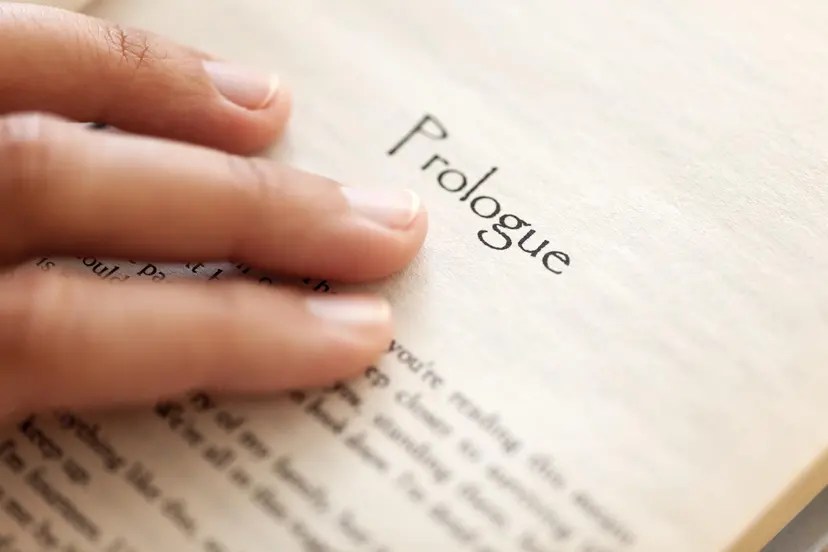
Blog Post #27: How to Write a Gripping Prologue Without Killing the Pacing!

Despite the fact that prologues are a staple among fantasy writers, prologues are often rejected in queries because they tend to slow the pace to a halt. Here’s how to write a killer prologue without killing the pacing!

A writer posted in a FB group I’m in about how to edit a prologue they had written. Their friend is an artist who did beautiful artwork for the scenes depicted in the prologue, but the writer also was told to keep the prologue less than five pages, per the current trend. She was at a loss of how to achieve keeping all of her scene while also keeping it to five pages.

In my response I feel I had the makings for a wonderful article on prologues, so here we are. And here we go.

Per Penguin’s Reference Library’s Dictionary of Literary Terms and Literary Theory (2013), a prologue is: The opening section of a work; a kind of introduction which is part of the work and not prefatory. It was common in drama in the 17th and 18th century, when it was often in prose. Occasionally found in novels. In plays the prologue is usually a chorus.

In most stories I’ve read the prologue is a scene that takes place either in the past or in the future of the main story’s timeline.

In the best instances a prologue can be a strong hook which keeps the reader reeled into the story. In the worst instances, it’s a boring mess that halts a reader’s interest entirely!

So, what makes the difference?

1) LIMITED Purpose.
Here’s the true “meat and potatoes” of the conversation: what are you trying to achieve with this prologue? Are you giving the audience a cliff hanger in the beginning of the manuscript to get them hooked? That, in reality, is really the only reason you should use a prologue. A prologue should be used as a HOOK for the reader to latch on to your story, there is basically no other reason to have one.

If you planned on using your prologue as an information dump: DON’T!
If you planned on using your prologue just to show how cool your main character is: DON’T!
If your prologue is just an exercise in how detailed you can describe things that don’t matter to your plot: DON’T!

These are cheap tricks that your audience will see through. You are not the first author that has tried to include a prologue of droning purple prose and waxing poetic about how misunderstood your character is, thousands of books start that way, and they’re all bad.

The prologue should be used to drive the plot, period. It’s a tool to get your reader hooked on the story, so make it dramatic and DEFINITELY have something happen that is FUNDAMENTAL to your story. It needs to be fundamental to both the plot of the story and, for extra credit, vital to your main character’s (or villian’s) wound.

2) The Stakes.
Following up with the need for drama, your story’s stakes are the entire reason your audience is here! They want DRAMA, but the specific flair of drama that comes from your genre, of course! Your prologue should be carving out at least a few of the stakes while also dropping minimal information. If your audience doesn’t catch at least a whiff of conflict, they won’t stay. We’re here for the fireworks. We’re here for the conflict!

Let’s look at some examples, specifically with fantasy:

Robert Jordan’s The Eye of the World did start with a prologue called Dragonsmount (I have a newer copy now that added an additional scene called “Ravens” but the old one from the 90’s did not have this, it started with Dragonsmount).

Dragonmount is a scene depicting two characters: the villain Elan Morin, who claims he is reveling in his moniker “Betrayer of Hope” and Lews Therin, a powerful warrior mage now known as The Dragon. Lews Therin realizes he’s been possessed by madness and in that fugue state he killed off his lover and their family. The villain, Elan Morin, Betrayer of Hope, tells Lews that the madness which overtook him was a curse from the Dark Lord as retribution for Lews’s service to the light. Then Elan Morin begins to torture Lews with lightening magic. Lews essentially goes Super Saiyan, turning into a burning ball of fire and melting down the entire castle until only the mountain remained. Elan Morin, Betrayer of Hope, watches this and says that the Dragon cannot escape him for long, and that their time is still to come.

In this scene alone we get the villain, tastes of how the magic system works, a taste of the mythology, a dash of trauma and despair, and a heroic character promised to return. Now that’s a prologue, and arguably the MC of the first book ISN’T EVEN IN THIS SCENE.

Another beloved example would be the opener to the Harry Potter series. The first chapter in The Sorcerer’s Stone is called The Boy Who Lived, where three magical beings (McGonagall, Hagrid and Dumbledore) leave a baby boy on his aunt’s doorstep because she’s the only family he has left and a psychopathic wizard just killed his parents (and tried to kill him, too). The boy must stay in hiding, so that he may live. So that his parent’s sacrifice wasn’t for nothing.

In this scene we get: the villain’s impending danger, the protagonist, three major characters who play major roles throughout the entire story, the knowledge that Harry is famously known as “The Boy who Lived” to an entire group of people, the backstory of why the Dudley’s don’t see Harry as their own, and the promise of something more to come with this main character.
(We even get a shout out to Sirius Black on page 14 ((where Hagrid borrowed the motorcycle)), a character who doesn’t arrive until the third book and is fundamental to the story overall!)

By comparing these two prologues we can see what a prologue should deliver: relevant characters who will return later, major discussion of/outright showing the major conflict, trauma/drama/intrigue, and some small world building tidbits. This is the formula for your prologue. If the prologue is short of this in anyway, it’s not really an intriguing prologue, it’s a random scene in the beginning of your manuscript!

So, if you’re thinking about adding in a prologue, I implore you to ask yourself why, and to ensure you make it a powerful punch! Thank you for reading! I’m escaping to the beach for the weekend! I’ll be back Monday with more writing advice!

Short Story: Dejavu – Part 5 Finale


“This is where you want dropped off?” The truck driver asked, his eyes peering down from his opened window. Rain pelted the eighteen-wheeler, dripped down into the man’s console controls. The truck was pulled over to the side of the road, its hazard lights blinking in the fog from the storm. The driver’s eyes scanned across the forest surrounding the rural road.

“Yup,” James said. He stood outside of the driver’s door, a broad smile across his face.

“I can’t imagine why you would want to be dropped off here,” the man said. “There’s not a soul in sight.”

James just smiled at the man and waved to him. “Thank you man, I really appreciate the ride.”

The truck driver shook his head, waved back, and pulled back onto the road. As the man pulled away, James’s constant migraines immediately subsided. James felt the man’s thoughts stretch like taffy and dislodge out of his mind as the man drove. It had finally happened. The silence had come. No more would James be plagued by floating thoughts of anyone surrounding him. No more would he have to hide in his tiny, dark apartment in a giant city, where the windows were tapped shut so he couldn’t see anyone outside. Never again would his home be barraged by people begging for him to push himself past the brink.

No cars came down the dirt road in the fifteen minutes James soaked in the silence. It was the first time in James’s life that all he could hear was the rain, and he sobbed. He sobbed for both the relief he felt by being completely alone and the loneliness that he would have to relegate himself within for the rest of his life. This was not the first time he had to flee, every time word would spread about his abilities he’d pick up and move, hoping to learn from his past mistakes and manage to live a normal life in society. Now, for the first time, he saw the truth. People would always try to take from him more than he could give. He could never be around them again.

Alone. Alone was the only way he’d survive now. With his own two hands in solitude.


Thank you all for sticking with me through this short story! I will be submitting this for publication soon, and thus this series will only be up on my blog for a limited time. I will begin a new short story next Wednesday!